How deep is a standard kitchen countertop? A standard kitchen counter depth is typically about 25 inches. This measurement includes a small overhang past the front of the base cabinets underneath. This standard countertop depth is designed to work well with common kitchen appliance sizes and standard kitchen design dimensions. It provides enough workspace for most cooking tasks and fits nicely in typical kitchen layouts.
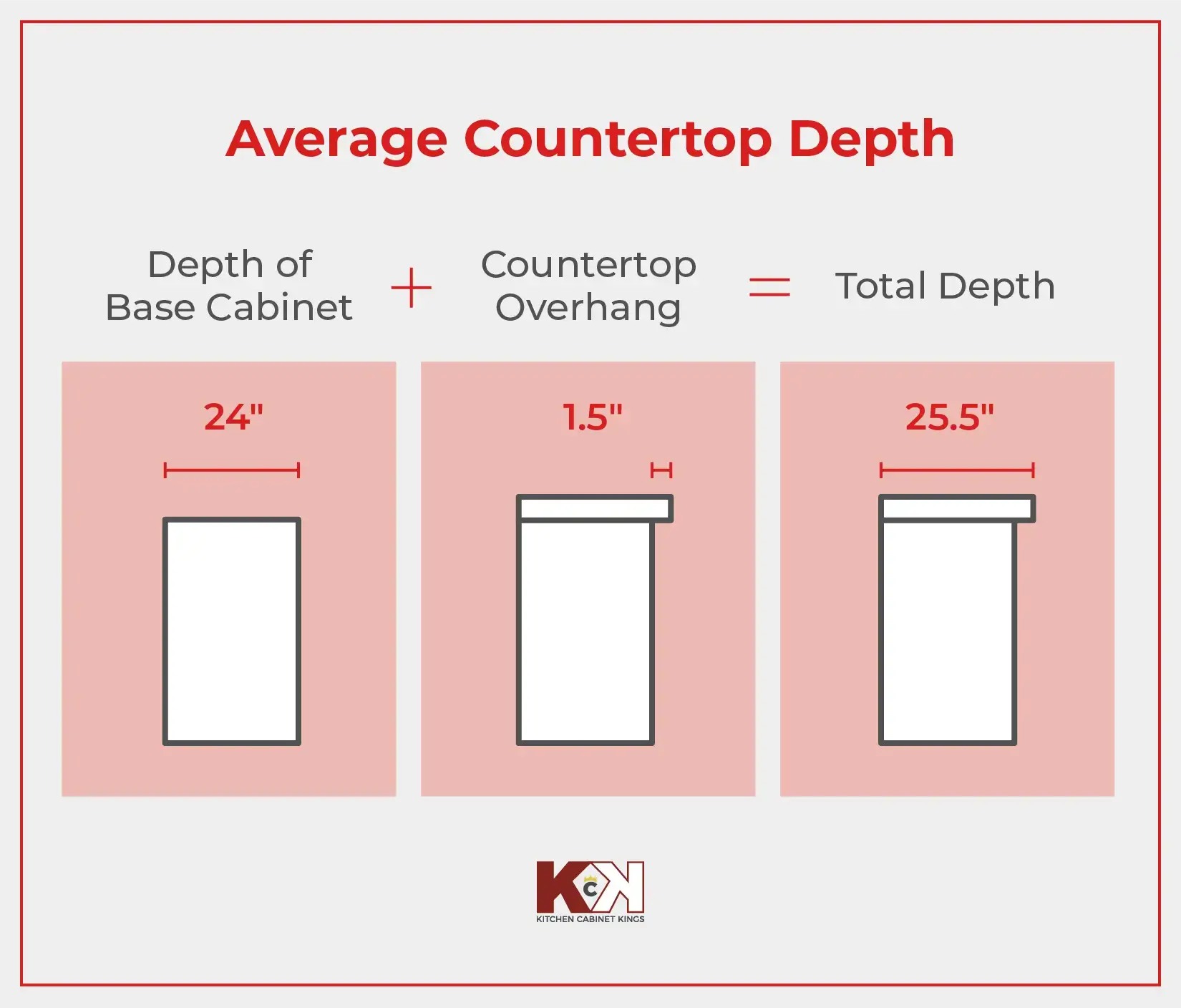
Image Source: cdn.kitchencabinetkings.com
What Defines the Standard Counter Depth?
When people talk about the kitchen counter depth standard, they mean the typical measurement from the wall to the front edge of the countertop. This standard isn’t random. It comes from the sizes of other kitchen parts.
The biggest factor is the depth of the base cabinet depth kitchen. Most kitchen base cabinets are made about 24 inches deep. This measurement is from the front of the cabinet box to the back. It does not count the cabinet door thickness.
On top of this 24-inch deep cabinet sits the countertop. The counter usually sticks out a little bit past the front of the cabinet doors or drawers. This is called the countertop overhang standard. The standard front overhang is usually about 1 inch to 1.5 inches.
So, if you add the standard cabinet depth (24 inches) and the standard front overhang (1 inch), you get the standard countertop depth: 24 inches + 1 inch = 25 inches.
This 25-inch depth is the average kitchen counter depth you will find in many homes. It’s a common measurement for ease of design and use.
Deconstructing Typical Kitchen Countertop Dimensions
Let’s break down the numbers for typical kitchen countertop dimensions. The main dimension we are looking at here is depth.
- Cabinet Box Depth: Standard base cabinets are about 24 inches deep. This is the main support for your countertop.
- Countertop Material Thickness: The thickness of the countertop material varies. Common thicknesses are 3/4 inch (like some solid surfaces or thinner stones) or 1.25 inches (like thicker granite or quartz). This thickness doesn’t change the depth from front to back, but it matters for the edge look and sink installation.
- Front Overhang: As mentioned, the
countertop overhang standardat the front is typically 1 inch to 1.5 inches. This overhang serves a purpose. It helps protect the cabinet fronts from spills and drips. It also provides a comfortable edge for you to stand at while working, keeping your feet from hitting the cabinets. - Back Gap/Scribe: There is sometimes a small gap at the back of the countertop, against the wall. This gap, often around 1/4 inch to 1/2 inch, is used to “scribe” or slightly shape the back edge of the counter to fit perfectly against a wall that isn’t perfectly straight. The countertop fabricator cuts the material to match the wall’s shape. This small gap is usually hidden by a backsplash. When calculating the total finished depth from the wall, this scribe gap is part of the overall cut dimension but is filled or hidden by the backsplash. For practical purposes, when we say 25 inches, we mean the depth from the wall surface (where the backsplash sits) to the front edge of the counter.
So, the 25-inch standard countertop depth is a practical measurement. It comes from the 24-inch deep cabinet, plus the needed front overhang, accounting for fitting against the wall.
Here is a simple look at the parts:
| Component | Typical Size | Purpose |
|---|---|---|
| Base Cabinet Depth | ~24 inches | Main support structure |
| Front Counter Overhang | 1 – 1.5 inches | Protects cabinets, provides toe space |
| Back Scribe/Gap | ~0.25 – 0.5 inches | Allows fitting to uneven walls (hidden) |
| Total Depth | ~25 inches | Standard finished depth from wall |
This combination makes the 25-inch depth the functional standard for most kitchens.
Why Standard Dimensions Are Common
Sticking to standard kitchen design dimensions makes things easier and often cheaper.
- Appliance Fit: Kitchen appliances like dishwashers, ranges, and refrigerators are designed to fit with standard cabinets and countertops. A standard depth countertop works well with slide-in ranges, allowing the counter edge to overlap the range sides slightly for a built-in look. Dishwashers fit under the standard height (around 34.5 inches for cabinets plus counter).
- Cabinet Availability: Base cabinets come in standard depths (mostly 24 inches) and widths. Using standard sizes means cabinets are readily available from many makers. This lowers cost and speeds up delivery times compared to custom sizes.
- Ease of Installation: Countertop fabricators and installers are very used to working with the 25-inch standard depth. Their tools, processes, and material ordering are set up for this size. This makes installation smoother and less likely to have issues.
- Material Cost: Countertop slabs (like granite, quartz, etc.) are often cut to yield standard depths with minimal waste. Asking for non-standard, slightly smaller or larger depths might lead to more material waste from the slab, which can increase your cost.
- Compatibility: Sinks and cooktops are designed to fit within standard
kitchen counter depth standarddimensions. Many sink cutouts require a certain amount of material depth behind and in front of them for support and faucet placement. Standard depths usually provide this needed space.
Using the average kitchen counter depth of 25 inches is a practical choice for many homeowners and builders. It balances workspace needs, appliance compatibility, and cost efficiency.
Fathoming Different Countertop Depth Options
While 25 inches is the standard countertop depth, it’s not the only choice. There are several countertop depth options available, depending on your needs and kitchen layout.
Deeper Countertops
Some people choose deeper countertops. These might be anywhere from 26 inches to 30 inches deep, or even more. Why would someone choose deeper counters?
- More Workspace: An extra few inches of depth can make a big difference, especially if you love to cook or bake. More space for chopping, mixing, and spreading out ingredients is a big plus.
- Larger Appliances: Some appliances, like certain types of cooktops or large farmhouse sinks, might need more depth than the standard 25 inches for proper installation and surrounding counter space.
- Behind-the-Range Space: If you have a freestanding range (which sticks out from the wall more than a slide-in), a deeper counter can help hide the gap behind the range. Some people might even extend the counter back by 3-4 inches behind a freestanding range to create a small shelf space for spices or oils.
- Better Fit for Deep Refrigerators: While refrigerators usually stick out from the counter depth, having slightly deeper counters on cabinets next to a deep fridge can make the fridge look less prominent and more integrated.
- Ergonomics: For taller individuals, a slightly deeper counter might feel more comfortable, allowing them to lean in slightly without hitting cabinets.
Choosing deeper counters usually means you need deeper base cabinets or need to pull standard cabinets away from the wall. Pulling cabinets away from the wall creates a gap behind them, which needs to be planned for. This adds complexity and cost.
Shallower Countertops
Shallower countertops are less common in main kitchen areas but might be used in specific situations. They could be 23 inches or 24 inches deep.
- Very Small Kitchens: In tiny spaces, saving an inch or two might seem helpful, but it often compromises needed workspace and appliance fit.
- Specific Cabinetry: Sometimes, older or non-standard cabinets might be shallower.
Using shallower counters often creates issues with standard sinks and cooktops, which are designed for more depth. It also reduces valuable workspace. Generally, it’s best to stick close to the standard or go deeper if space allows, rather than shallower.
Custom Depths
For unique kitchen designs, countertop depth options are unlimited with custom work. You can get counters made to any depth you need. This is often required for:
- Unusual room shapes.
- Integrating very specific, non-standard appliances.
- Creating multi-level or varying-depth countertop areas within one kitchen.
Custom depths are the most flexible option but also the most expensive. They require careful kitchen counter measurements and detailed planning.
Kitchen Island Counter Depth Variations
The kitchen island counter depth doesn’t always follow the standard 25 inches of perimeter counters. Islands often serve multiple functions, leading to different depth needs.
- Workstation Island: If an island is only for prep work, it might follow the standard 25-inch depth.
- Island with Seating: If the island includes seating (like stools), the countertop must be deeper on the seating side to allow comfortable legroom. A typical overhang for seating is 12 inches for counter-height stools (about 36 inches high) and 15-18 inches for bar-height stools (about 42 inches high). So, an island with a standard 24-inch deep cabinet base and 12 inches of seating overhang would be 24 + 12 = 36 inches deep on the seating side. The other side might be standard depth, or the entire island might be deeper.
- Island with Sink or Cooktop: Islands often house sinks or cooktops. These appliances need specific clearance behind and in front. This might require the island countertop to be deeper than 25 inches, even without seating. A minimum depth of around 30-36 inches is often needed to fit a sink or cooktop and still have usable counter space in front and behind.
- Larger Prep Area: Islands are perfect for creating a large, uninterrupted workspace. A generous
kitchen island counter depth, maybe 36 or 42 inches, provides ample room for spreading out ingredients, multiple cooks working together, or large baking projects.
So, while standard countertop depth is key for perimeter counters fitting against walls and around appliances, the kitchen island counter depth is much more flexible and depends heavily on the island’s planned use.
Grasping the Factors for Your Depth Choice
Choosing the right countertop depth options for your kitchen involves thinking about several things.
Kitchen Size and Layout
- Small Kitchens: In a small kitchen, sticking to the
standard countertop depthof 25 inches usually makes the most sense. It gives enough workspace without making the kitchen feel cramped. Going deeper might block walkways. - Large Kitchens: In larger kitchens, deeper counters (26-30 inches) can add luxurious workspace without sacrificing needed floor space or flow. Islands in large kitchens can often accommodate very deep countertops with generous seating overhangs.
Appliance Choices
- Freestanding Range: These often stick out more. A deeper counter can help make the transition smoother.
- Slide-in Range: These are designed to fit with the
standard countertop depth(25 inches), with the counter lip covering the sides of the range. - Refrigerator Depth: While counters don’t align perfectly with fridges, deeper counters on nearby cabinets can create a slightly more integrated look for a standard-depth fridge. Counter-depth fridges are designed to align better with standard counters.
- Sink and Cooktop Location: If you plan a large or unusually shaped sink, or a specific cooktop, check its specifications. It might require more back-to-front depth than the standard 25 inches provides.
Functionality and Use
- Cooking Style: Do you do a lot of baking, which requires spreading out? Do you prep many ingredients at once? More depth can be very helpful.
- Multiple Cooks: If more than one person is often working in the kitchen, deeper counters allow people to work opposite each other or side-by-side more comfortably.
- Appliances on Counter: Do you keep appliances like a stand mixer or coffee maker on the counter? Deeper counters give you more space in front of these items.
Ergonomics and Accessibility
- User Height: As mentioned, taller people might find slightly deeper counters more comfortable.
- Accessibility Needs: For wheelchair users, different counter depths and heights are needed. Standard depths might not be suitable.
Budget
Custom or non-standard depth countertops will cost more than standard 25-inch ones. This is due to increased material waste and more complex fabrication and installation. Deeper base cabinets also cost more than standard 24-inch ones.
Considering these factors helps you decide if the standard countertop depth is right for you or if you should explore other countertop depth options.
Interpreting Kitchen Counter Measurements
Getting accurate kitchen counter measurements is vital, whether you are keeping the standard depth or going custom. Here’s how to approach it simply:
- Measure the Base Cabinets: Start by measuring the depth of your installed base cabinets. Measure from the wall to the front face of the cabinet box (not including doors or drawers). This is usually around 24 inches for standard cabinets.
- Consider the Overhang: Think about how much front overhang you want. The
countertop overhang standardis 1 to 1.5 inches. This is the distance the counter will stick out past your cabinet doors/drawer fronts. - Measure from Wall to Front Edge: The most important measurement for the countertop fabricator is the total depth from the wall to the desired finished front edge of the counter.
- Place one end of your tape measure at the wall.
- Extend it straight out, keeping it level, to where you want the front edge of the counter to be.
- For standard depth, this will be about 25 inches. For deeper counters, measure out further.
- Do this in several spots along the cabinet run, as walls are often not perfectly straight. Note the largest measurement. The fabricator will likely cut the main part to the largest depth and then scribe the back edge to fit any wall variations.
- Account for Appliances: If you have a slide-in range or specific sink, check its cutout requirements. Ensure the measured depth leaves enough space behind and in front of the cutout area for proper support and faucet placement.
- Island Measurements: For islands, measure the cabinet base depth. Then add the desired overhangs on all sides (front, back for seating, sides if needed). Measure the total planned depth for the island from edge to edge.
Providing accurate kitchen counter measurements to your countertop provider is crucial for a good fit. Don’t just say “standard depth”; provide the actual measurement you expect from the wall to the front edge, and confirm it works with your cabinets and appliances.
The Impact of Depth on Kitchen Design
The kitchen counter depth standard of 25 inches, and any deviation from it, affects more than just workspace. It influences the overall look and feel of your kitchen.
- Aesthetics: Deeper counters can create a sense of luxury and substance in a larger kitchen. Shallower counters, if used, can make a kitchen feel smaller and less functional. The
countertop overhang standardalso affects the visual weight of the counter edge. - Flow: While a standard depth is unlikely to cause flow problems, significantly deeper counters in a narrow galley kitchen, for example, could reduce the walkway space and make the kitchen feel cramped.
Standard kitchen design dimensionsconsider typical walkway clearances. - Storage Access: Standard depth cabinets with standard depth counters allow easy access to items at the back of the cabinet. If you install deeper counters on standard 24-inch cabinets, the extra counter depth (say, 30 inches total) might make it harder to reach items pushed to the back of the 24-inch deep cabinet interior. Pull-out shelves or drawers are good solutions for deeper cabinet access.
- Backsplash: The gap between the counter and the wall (the scribe area) is where the backsplash typically starts. The
standard countertop depthassumes you will have a backsplash covering this small gap at the back.
Thinking about countertop depth options in the context of your whole kitchen plan helps ensure the design is functional and visually pleasing.
Installation Notes Affected by Depth
While installation details are usually handled by professionals, knowing how depth affects the process is useful.
- Weight: Deeper countertops mean more material, which means more weight. Very deep or long counter sections may need extra support, especially for heavy materials like stone.
- Seams: Countertop slabs come in specific sizes. Very deep counters might require more seams or seams in different locations than a
standard countertop depthwould. Fabricators plan seams based on slab size, counter layout, and depth. - Scribing: As mentioned, the back edge of the counter is often scribed to fit the wall. This requires skill to get a tight fit, especially with non-straight walls.
- Support: Standard base cabinets are designed to support a standard overhang. If you plan a significantly larger overhang (more than the
countertop overhang standardof 1-1.5 inches, especially on an island), you might need extra support like corbels or steel support rods, particularly for heavy stone.
Discussing your chosen countertop depth options and kitchen counter measurements in detail with your fabricator is key to a successful installation.
Summing Up the Standard
To recap, the standard countertop depth is widely accepted as 25 inches. This dimension is primarily set by the base cabinet depth kitchen (typically 24 inches) plus a standard countertop overhang standard at the front (1 to 1.5 inches). These typical kitchen countertop dimensions are part of broader standard kitchen design dimensions that help appliances, cabinets, and countertops work together seamlessly.
While 25 inches is the average kitchen counter depth, countertop depth options exist, including deeper counters for added workspace or fitting specific appliances, and varying kitchen island counter depth depending on function (especially seating).
Getting accurate kitchen counter measurements is essential for any project, standard or custom. Understanding why the standard is the standard helps you make informed choices for your own kitchen remodel or build.
Choosing the right countertop depth is a key step in creating a kitchen that is both beautiful and functional, providing the workspace you need for all your culinary adventures.
Frequently Asked Questions
Here are some common questions about kitchen countertop depth.
Q: Is a 24-inch counter depth too shallow?
A: A 24-inch counter depth is generally considered too shallow for a main kitchen counter that goes against a wall. Standard base cabinets are 24 inches deep, so a 24-inch deep counter would likely sit flush with or even be slightly behind the cabinet doors, offering no protective overhang and potentially causing clearance issues with sinks and faucets. The standard countertop depth of 25 inches provides the needed overhang and space.
Q: How much does countertop depth affect cost?
A: Countertop depth options can affect cost. If you choose a depth different from the standard countertop depth (25 inches), especially significantly deeper, it may increase cost. This is because:
* Deeper cabinets (if needed) cost more.
* More material is used per foot.
* Slabs might yield less efficiently, leading to more waste cost.
* Custom fabrication for non-standard depths can be more labor-intensive.
Q: How deep should a kitchen island counter be if it has seating?
A: The kitchen island counter depth with seating needs to accommodate the cabinet depth plus enough overhang for comfortable seating. For counter-height seating (stools at about 36 inches high), a 12-inch overhang is standard. For bar-height seating (stools at about 42 inches high), 15-18 inches is better. So, a typical island with seating might be 24 inches (cabinet) + 12-18 inches (overhang) = 36 to 42 inches deep overall on the seating side.
Q: Does the countertop material change the standard depth?
A: No, the type of material (like granite, quartz, laminate, wood) does not change the standard countertop depth itself. The standard refers to the finished dimension from the wall to the front edge, regardless of what the counter is made of. The thickness of the material can vary, but this affects the edge profile and sink mounting, not the overall front-to-back depth standard.
Q: Can I put a standard 25-inch deep countertop on shallower cabinets?
A: Yes, you can. If you have cabinets shallower than the standard 24 inches (common in older homes or sometimes in utility spaces), you can still install a standard countertop depth of 25 inches. However, this will result in a larger overhang at the front. While possible, a very large overhang (e.g., 3-4 inches) might look unusual and could require extra support, especially with heavy materials like stone. It’s best to match the counter depth reasonably close to the cabinet depth plus the standard overhang.
Q: What is the purpose of the standard countertop overhang?
A: The countertop overhang standard (typically 1 to 1.5 inches) serves several purposes:
* Protection: It directs spills away from the cabinet fronts, protecting the doors and drawers.
* Comfort: It provides toe space, allowing you to stand closer to your work area without hitting your feet on the cabinets.
* Aesthetics: It creates a finished look for the countertop edge.