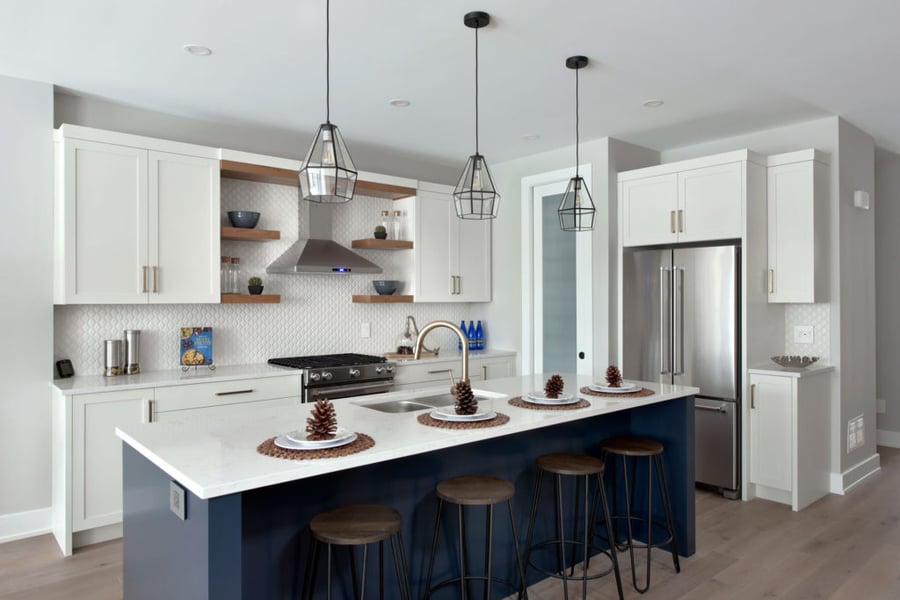
Image Source: www.deslaurier.com
Choosing the Right Island Overhang
Deciding how much overhang your kitchen island needs is key. For a comfortable place to sit, you typically need a countertop overhang of 12 inches. Some people find 9 inches okay, especially if space is tight, but 15 inches gives you even more room for your knees. This depth is a standard for kitchen island seating knee space and helps make your island a truly comfortable spot. The right island overhang for bar stools or chairs depends on the counter height, but the principle of needing enough knee room stays the same. This kitchen island countertop overhang depth is vital for its use as a breakfast bar or seating area.
Why Overhang Matters
An island overhang does a key job in your kitchen. It makes space for people to sit. Without overhang, you bump your knees on the cabinets below. It also adds workspace and changes the look of your island. A good overhang makes the island useful for eating, working on a laptop, or kids doing homework. It turns a simple workspace into a social spot.
Overhang for Sitting: The Key Measurements
The main reason for overhang is often seating. Giving people enough room makes them want to sit there. Too little overhang is uncomfortable. Too much can cause other problems, like needing lots of support.
Minimum Needs for Comfort
Let’s talk about the smallest amount you need.
* For counter-height seating (about 36 inches high), the very least amount of overhang you want is 9 inches. This is the minimum overhang for island seating. It gives just enough knee space for many people.
* For bar-height seating (about 42 inches high), you can sometimes get away with slightly less, maybe 8 inches. This is because your legs are straighter when sitting higher.
* For table-height seating (about 30 inches high), you need more room, closer to 18 inches. This is like sitting at a regular table.
Remember, these are minimums. They might not be truly comfortable for everyone, especially taller people.
Making it Truly Comfortable
To make your island seating truly comfortable, aim for more space.
* For counter height, the recommended island overhang is 12 inches. This is often called the standard kitchen island overhang for seating. Most adults find 12 inches of knee space comfortable for eating a quick meal or having a drink. This depth allows you to pull your stool close enough to the counter.
* For even better comfort at counter height, go for 15 inches. This extra space is great for spending more time at the island, like working or homework. It means you won’t feel cramped. This is a comfortable island seating depth that many people prefer.
Sitting at a Breakfast Bar
A breakfast bar is usually a raised part of the island, often at bar height (42 inches).
* The breakfast bar overhang standard is often 8 to 10 inches. Since it’s higher, your knees don’t stick out as much.
* Even at bar height, 12 inches provides more comfort, especially if people will sit there for more than a few minutes.
Picking Bar Stools
The type and size of your bar stools also matter.
* Make sure your stools can slide mostly under the overhang. This keeps walkways clear when nobody is sitting there.
* Check the stool’s height and width. You need enough space between stools.
* The island overhang for bar stools needs to match the stool height. A stool for a 36-inch counter needs 12 inches of knee space. A stool for a 42-inch bar needs at least 8-10 inches.
Standard Overhang Sizes
While custom islands are common, there are standard sizes people often use. Knowing these standards helps you plan.
Typical Kitchen Island Overhang
- No overhang: Some islands have no overhang on the sides or back. These are usually just for workspace or storage. They save space in smaller kitchens.
- 1-inch overhang: This is common on sides and the front where there’s no seating. It protects the cabinets below from spills. This is a standard countertop overhang for kitchen island edges.
- 3/4 inch overhang: Similar to 1 inch, just a little less. Also for edge protection.
- 12 inches overhang: This is the most common standard for seating areas at counter height. It balances comfort and the need for support. It is widely seen as the standard kitchen island overhang for seating.
Island Size with Seating
When you add seating, the total size of your island grows.
* Island Depth: If your island base cabinets are 24 inches deep (standard), and you add a 12-inch overhang for seating, the total countertop depth will be about 37-38 inches (24 inches base + 1 inch front overhang + 12 inches back overhang). Add an inch or so at the back for the counter edge past the overhang supports.
* Island Width: You need space for each person sitting. Allow at least 24 inches of width per person. So, for three stools, your seating area needs to be at least 72 inches wide.
* Kitchen island dimensions with seating must include these measurements. A typical island for two people might be 60 inches wide (24 inches per person + space between), with a 12-inch overhang. A larger island for four people might be 96 inches wide.
Here’s a simple table for planning seating width:
| Number of Seats | Minimum Island Width Needed (at seating edge) |
|---|---|
| 1 | 24 inches |
| 2 | 48 inches |
| 3 | 72 inches |
| 4 | 96 inches |
This is just for the seating part. The rest of the island needs width for cabinets, sinks, or cooktops.
Material and Support: What Countertops Need
The material your countertop is made from greatly affects how much overhang it can have without extra support. Heavy stone acts differently than light laminate.
Heavy Stone Overhang
Materials like granite, quartz, marble, and concrete are very heavy and can break if not supported well.
* Granite: Generally, granite needs support if the overhang is more than 10 inches. Some thin granite (3cm thick) can go up to 10 inches without support, but check with your stone supplier. Thicker granite might go a little further.
* Quartz: Similar to granite, most quartz needs support beyond 10 inches. Always follow the maker’s rules.
* Marble: Marble can be more fragile than granite or quartz. It often needs support for overhangs more than 6-8 inches.
* Concrete: Very heavy. Needs careful support planning for any significant overhang.
Going past these limits without support risks cracking or breaking the countertop. This is a major safety issue.
Lighter Surface Overhang
Materials that are lighter or more flexible can sometimes have a bit more overhang without needing extra support right at the edge.
* Laminate: Can often overhang up to 10-12 inches if the substrate (the wood base it’s glued to) is strong enough, like thick particleboard or plywood. Check how it’s made.
* Solid Surface (like Corian): Can often overhang up to 12 inches without extra support, sometimes even 15 inches, depending on the thickness and how it’s installed. Again, check the maker’s guide.
* Wood/Butcher Block: A thick wood top (like 1.5 inches or more) can often overhang 12-15 inches without edge supports, as long as it’s attached well to the base. The wood itself provides stiffness.
Always check the rules for your specific countertop material. The thickness and how it’s made matter a lot.
Adding Support for More Overhang
If you want more overhang than your material allows on its own, you must add support. This is very important for safety and protecting your expensive countertop.
Common ways to add support:
* Corbels: These are decorative brackets often made of wood or metal. They attach to the island base and stick out to hold up the counter. They can look nice but can get in the way of knees or stools if not placed carefully.
* Hidden Brackets/Steel Plates: These are strong metal supports that attach under the countertop and into the island structure. They are often L-shaped or flat plates. The best ones are flat and slide into routes cut into the top of the island base or the bottom of the countertop itself, making them almost invisible. This is ideal for allowing clear knee space.
* Support Legs or Columns: Adding legs or columns at the edge of the overhang provides strong support. This changes the look of the island and does take up space where a stool might go, but it’s very sturdy.
* Full-Height Walls/Cabinets: Extending a wall or cabinet run under part of the overhang provides solid support for that section.
How much support do you need?
* For heavy stone over 10 inches, you need support that holds about two-thirds of the overhang amount. So, for a 15-inch overhang, the support should reach about 10 inches under the stone.
* Supports should be placed regularly along the overhang edge, often every 16 to 24 inches.
* Make sure the support is strong enough for the weight. Steel is much stronger than wood corbels.
Choosing the right support depends on:
* The overhang depth.
* The countertop material and thickness.
* How you want the island to look (do you want supports to show?).
* Your budget.
Don’t skip support if it’s needed. A broken countertop is costly and dangerous. Ask your countertop installer or a kitchen designer what is needed for your specific plan.
Other Things to Think About
Overhang depth isn’t the only thing that makes an island with seating work well.
The Right Bar Stool Height
Matching your stool height to your counter height is key for comfort.
* Counter Height (36 inches): You need stools that sit about 24-26 inches high.
* Bar Height (42 inches): You need stools that sit about 28-30 inches high.
* Table Height (30 inches): You need chairs or stools that sit about 18 inches high.
If the stools are too low, you reach up to the counter. If they’re too high, your knees hit the underside of the counter, even with enough overhang.
Room to Walk Around
Think about the space around your island, especially behind the seating area.
* You need room for people to sit at the island.
* You need room for people to walk behind them.
* You need room for people to walk behind them when someone is seated.
- Minimum walkway space: At least 36 inches of clear floor space around the island is needed for a single walkway.
- Better walkway space: 42 inches is much better, allowing one person to easily walk past another.
- Walkway space behind seating: If there is a wall or cabinets right behind the seating, you need at least 44 inches from the edge of the overhang to the wall/cabinets. This lets someone squeeze past a seated person.
- Walkway space behind seating with traffic: If the space behind the seating is a main path in your kitchen, aim for 48-60 inches from the overhang edge. This allows people to walk freely even when seats are used.
This clear space is part of planning the overall kitchen island dimensions with seating. It affects how big your island can be and where it can go in the room. Don’t let a large overhang eat too much into needed walkway space.
The Total Island Size
The overhang adds to the total size of your island top.
* A standard island base might be 24 inches deep and 60 inches wide.
* Adding a 1-inch overhang on the front and sides makes the top 25 inches deep and 62 inches wide.
* Adding a 12-inch overhang for seating on the back makes the top 25 inches deep on the sides, 25 inches deep on the front, and 37 inches deep where the seating is (24-inch base + 12-inch overhang + maybe 1 inch for rear edge). The width remains 62 inches (if overhang is only on one end).
So, the kitchen island dimensions with seating are bigger than just the cabinet base size. Always plan with the full countertop size in mind.
Putting it All Together: Planning Your Island
Planning your island involves bringing together all these points. Think about how you will use the island most.
Step-by-Step Planning
- How will you use the island?
- Just extra workspace and storage? (Maybe no seating overhang needed, just 1 inch).
- Quick breakfast spot for two? (Maybe 12 inches overhang for 48 inches width).
- Family homework center or entertaining spot? (Maybe 15 inches overhang for 72+ inches width).
- How many people need to sit? This sets the minimum width of the seating area (24 inches per person).
- What height will the seating be? Counter height (36″) or bar height (42″)? This sets the target overhang depth (12″ standard for counter, 8-10″ for bar).
- What countertop material do you want? Stone, laminate, wood? This tells you how much overhang needs extra support.
- Based on overhang needs and material, what support is required? Corbels, hidden brackets, legs? Plan these into the island design.
- How much space is around the island? Can you fit the desired island size (base + overhang) and still have enough walkway space (36-60 inches)? This might limit your overhang or island size.
- Choose your stools. Make sure their height and width fit the overhang and the planned spacing.
Example: You want seating for 3 people at counter height, using quartz.
* Need 72 inches minimum width for seating.
* Want comfortable 12-inch overhang for counter height.
* Quartz typically needs support over 10 inches.
* Plan for hidden steel support brackets every 18-24 inches along the 72-inch seating width.
* Ensure you have at least 44 inches of clear space behind the 12-inch overhang to a wall, or 48-60 inches if it’s a main path.
* Select 24-26 inch high stools.
This step-by-step process helps make sure your kitchen island countertop overhang depth works well with the rest of your kitchen.
Common Questions about Island Overhangs
Here are some frequent questions people ask when planning their island overhang.
h5 Can an island have no overhang?
Yes, some islands have no overhang. They might be used only for work, storage, or holding a sink or cooktop. This saves space and can make the island look more like a solid block of cabinets.
h5 What if my kitchen is small?
In a small kitchen, every inch counts.
* You might choose a smaller overhang, like 9 inches instead of 12, if space is tight.
* You might choose an island with seating only on one side, or just for two people.
* You might need to use a material that can go further without support (like thicker wood or laminate) to avoid bulky corbels that stick out.
* Always prioritize needed walkway space over a large overhang.
h5 Can I have overhang on all four sides?
Yes, if your island is large enough and centered in the room. An island with overhang on all sides can be accessed from anywhere and allows seating on multiple sides. However, you need lots of space around it for this to work. You also need to plan support for overhangs on multiple sides.
h5 How much does the thickness of the countertop matter?
Countertop thickness matters a lot for how much overhang is possible without support.
* Thicker stone (3cm or about 1.2 inches) can usually go further unsupported than thinner stone (2cm or about 0.8 inches).
* Thicker wood or laminate tops are also stiffer and can span further.
* Always check the specific requirements for the thickness and type of material you choose.
h5 How far should supports go under the overhang?
For heavy materials like stone, supports should ideally reach about two-thirds of the way across the overhang. For a 12-inch overhang, the support should extend 8 inches under the counter. For a 15-inch overhang, it should extend 10 inches. This gives good strength where the counter is most likely to break under weight.
h5 Can I add overhang to an existing island?
It can be hard to add overhang to an existing island, but sometimes it’s possible.
* You might need to replace the entire countertop with a larger one that includes the overhang.
* Adding support structures (like corbels or legs) might be possible if the island base is strong enough to attach them.
* Adding hidden support often requires changing the top of the island base cabinets or routing the underside of the new countertop, which is tricky after installation.
* It’s usually easier and safer to plan for the overhang during the initial design or remodel.
h5 Does the island base need to be special for overhang?
Yes, the island base needs to be built to handle the weight of the countertop, especially with an overhang. It must be strong enough to:
* Hold the weight of the countertop itself.
* Provide a strong place to attach any support structures (corbels, brackets).
* Support the weight of people leaning on the overhang (though it’s not designed for sitting on!).
A standard cabinet box might need extra bracing inside or a strong plywood top added before the countertop goes on, especially if heavy stone and large overhangs are planned.
Choosing the right kitchen island countertop overhang depth involves thinking about seating comfort, countertop material needs, and the space you have. By planning carefully and using the right supports, you can create an island that is both beautiful and useful.