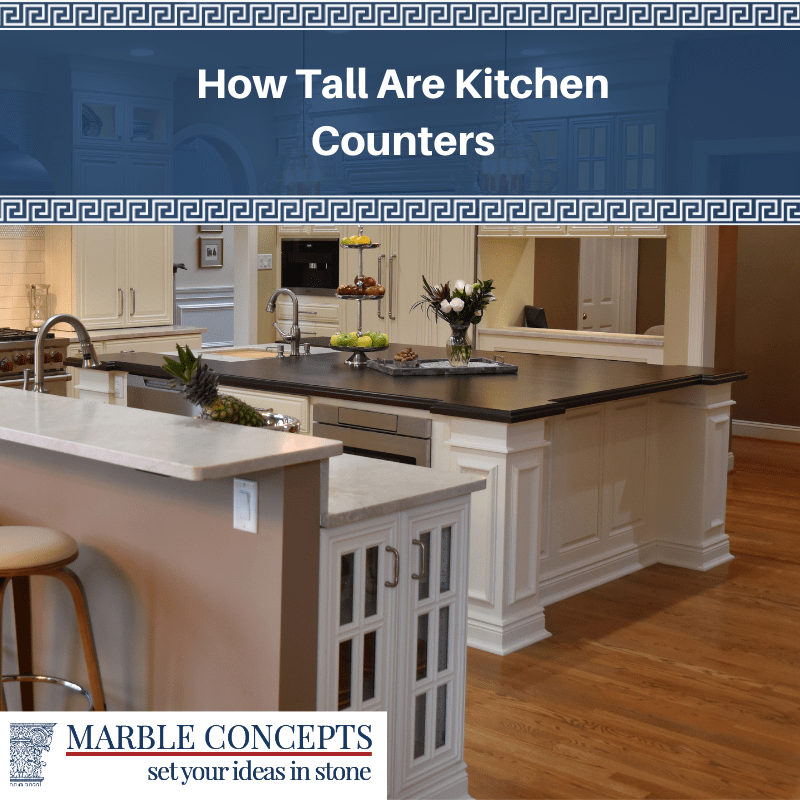
Image Source: marble-concepts.com
Standard Kitchen Counter Height: How Tall Is Kitchen Counter?
The standard height for a kitchen counter, including the countertop, is typically 36 inches (or 91.44 centimeters) from the finished floor. This measurement comes from the base cabinet height, which is usually 34.5 inches, plus the thickness of a standard countertop material like laminate, solid surface, or engineered stone, which adds about 1.5 inches. This 36-inch height is the average kitchen countertop height you will find in most homes.
Figuring Out Standard Counter Height
The 36-inch measurement didn’t just appear randomly. It became the standard kitchen counter height over time. People found this height comfortable for most kitchen jobs. These jobs include chopping food, mixing things, and washing dishes. It fits what most people need. This height works well for someone of average height to stand and work without bending too much. Bending over can hurt your back.
The average kitchen countertop height is based on the standard size of base cabinets. Base cabinets sit on the floor. They form the base for your countertops. Most companies make these cabinets 34.5 inches tall. This is the height without the countertop. When you add a common countertop that is 1.5 inches thick, you get the total height of 36 inches. This is the standard kitchen counter height seen in most kitchens.
Components Making Up the Height
Knowing how the total height is reached helps you understand the standard.
Here are the main parts:
- Base Cabinet: This is the box part of the cabinet that sits on the floor. Its standard height is 34.5 inches.
- Toe Kick: This is the space at the bottom front of the cabinet. It is usually 3.5 inches high and 3 inches deep. This lets you stand closer to the counter comfortably. Your toes go into this space. It is part of the 34.5-inch base cabinet height.
- Countertop: This is the slab on top of the cabinet. Its thickness changes based on the material.
- Laminate tops are often 1.5 inches thick.
- Solid surface, granite, or quartz can be 1.25 inches to 1.5 inches thick.
- Some custom tops can be thicker or thinner.
- Finished Floor: The measurement starts from the floor surface you walk on. This means after tiles, wood, or other flooring is put down.
When you add the standard base cabinet height (34.5 inches) and a common countertop thickness (1.5 inches), you get the standard 36 inches. This is why 36 inches is the common number for countertop height standards.
Why 36 Inches Became the Norm
This standard height became popular for good reasons. It works okay for many people.
Let’s look at why:
- Ergonomics for Many: Ergonomics is about designing things for people to use easily and safely. A 36-inch counter is often called an ergonomic kitchen counter height. It is designed for the average person to stand comfortably. For someone around 5’3″ to 5’10” tall, this height lets them work with less strain on their back and shoulders.
- Reaching and Working: At 36 inches, most people can reach the back of the counter easily. They can also apply enough pressure for tasks like kneading dough or chopping hard vegetables without stooping or reaching too high.
- Appliance Fit: Dishwashers and other under-counter appliances are made to fit under a standard 34.5-inch cabinet opening, leaving room for the countertop above. This makes installing appliances easier in a kitchen with standard heights.
- Building Simplicity: Using a standard base cabinet height simplifies design and building. Cabinet makers build standard sizes. Builders know what size to expect. This helps keep costs down and makes kitchen projects go faster.
While 36 inches is standard, it doesn’t mean it’s perfect for everyone. People come in different sizes. What is a comfortable counter height for one person might not be for another. We will talk more about this later.
Different Heights in the Kitchen
Not all surfaces in a kitchen are the same height. There are often different levels for different uses.
Knowing these helps when planning your kitchen layout.
Kitchen Island Height
A kitchen island is a freestanding counter unit. Its main counter surface often matches the height of the other counters. So, the standard kitchen island height is also usually 36 inches.
Why keep it the same?
- Seamless Workspace: A 36-inch island continues your main workspace. You can move from your counters along the wall to the island and keep working at the same level. This is good for preparing large meals.
- Cabinet Matching: Many kitchen islands are made using standard base cabinets. This naturally makes the island counter height 36 inches.
However, islands can also have different heights as part of their design.
Breakfast Bar Height
A breakfast bar is usually a raised counter area. It is often part of an island or a peninsula (a counter attached to a wall at one end). The main use is for casual eating or sitting and talking while someone cooks. Because people sit on stools, the height is higher than a standard counter.
The typical breakfast bar height is around 42 inches (about 106.68 centimeters). This height works well with bar stools. Bar stools are taller than counter-height stools. This lets people sit comfortably with their knees under the counter. It also creates a visual break between the main work area and the seating area. This higher level can also hide some kitchen mess from people sitting there.
Counter Height vs Bar Height
It’s helpful to clearly see the difference between standard counter height and breakfast bar height.
- Standard Counter Height: About 36 inches. Used for food prep, cooking, washing. People usually stand here. If seating is included, it needs “counter height stools” (seat height around 24-26 inches).
- Breakfast Bar Height: About 42 inches. Used for casual eating, serving, gathering. People sit on “bar height stools” (seat height around 28-30 inches).
Understanding counter height vs bar height is key for designing a kitchen with seating or different work zones.
Other Potential Heights
While 36 inches is the most common standard, other heights exist and can be useful.
- Lower Counters: Some kitchens include sections that are lower, maybe around 30-32 inches.
- This height is good for tasks like rolling dough, which is easier when you can lean over a bit.
- It is also a comfortable desk height for sitting.
- Lower counters are often used to meet ADA kitchen counter height rules for people in wheelchairs. We’ll cover ADA more later.
- Higher Counters: For very tall people, a counter slightly higher than 36 inches might be more comfortable. This could be 37 or 38 inches. This helps them avoid bending over.
Using different heights creates zones for different jobs and different people.
Ergonomics and Comfortable Counter Height
Ergonomics is about making things fit the person using them. A comfortable counter height is very important in the kitchen. You spend a lot of time standing at counters. The wrong height can cause pain in your back, neck, and shoulders.
Finding Your Comfortable Height
What feels comfortable depends on your height and the task.
A common rule of thumb for finding a comfortable height for chopping is:
- Stand up straight next to the counter.
- Bend your elbow to a 90-degree angle.
- Measure the distance from your elbow to the floor.
- Subtract 6 inches from that measurement.
This resulting height is often a good working height for that person for tasks like chopping. For many people, this calculation results in a height around 36 inches. But if you are shorter or taller than average, your ideal comfortable counter height might be different.
Task-Specific Ergonomics
Different kitchen tasks work best at different heights:
- Chopping and Prep: Often best when the counter is about 6 inches below your elbow (as in the rule above). This lets you put weight on your hands comfortably.
- Stirring on a Cooktop: A cooktop needs to be low enough that you can easily see into pots and stir without lifting your arm too high. Standard range tops are usually around 36 inches high, which works for many.
- Washing Dishes: If your sink is installed from the top (drop-in sink), the rim adds height. If it’s installed from below (undermount sink), the sink bottom is lower than the counter. This changes the working depth. For washing, a slightly higher counter might help some people avoid bending over the sink basin.
- Baking: Tasks like kneading dough or rolling pastry are often easier on a slightly lower surface (maybe 30-32 inches). This lets you use your body weight more effectively.
Because people do many different tasks, the standard 36 inches is a compromise. It’s okay for many things but not perfect for everything or everyone. Designing a kitchen with zones at different heights can offer better ergonomics.
Planning for Different Needs: ADA Standards
The Americans with Disabilities Act (ADA) provides guidelines for making spaces usable for people with disabilities. This includes kitchen design. ADA kitchen counter height rules are important if you need to design a kitchen that is accessible for wheelchair users.
ADA Counter Height Requirements
For a forward approach (someone facing the counter directly from a wheelchair), the counter surface should be no higher than 34 inches from the finished floor.
Key points for ADA counters:
- Height: Maximum 34 inches.
- Knee Clearance: There must be clear space underneath the counter for knees and toes. This space should be at least 30 inches wide, 27 inches high, and 19 inches deep. This means open space, no cabinets or drawers blocking it.
- Sink: If a sink is in an accessible counter, it must have clear knee space underneath and a maximum depth of 6.5 inches. Faucets should be easy to use.
Designing an entire kitchen to meet ADA standards means more than just counter height. It includes aisle widths, appliance placement, and storage. But the counter height is a key part of making the workspace usable from a seated position.
Even if you don’t need a full ADA kitchen, including a section of lower counter (30-34 inches) can make the kitchen more usable for someone in a wheelchair, a child, or just for sitting tasks. This is part of universal design – making spaces work for people of all ages and abilities.
How Countertop Material Affects Height
We mentioned that the base cabinet is 34.5 inches, and the countertop adds the rest to get to 36 inches. The type and thickness of your countertop material play a role in the final standard kitchen counter height.
Common materials and their typical thicknesses:
- Laminate: Often 1.5 inches thick. This is a common thickness that fits the standard perfectly.
- Solid Surface (like Corian): Usually 0.5 inches or 1 inch thick. However, it is often built up at the edge to look thicker, commonly 1.5 inches.
- Engineered Stone (Quartz): Common thicknesses are 1.2 cm (about 0.5 inches), 2 cm (about 0.75 inches), or 3 cm (about 1.2 inches). Most residential countertops use 2 cm or 3 cm. If you use 2 cm, the fabricator might add a layer to the edge to make it look thicker or sit higher. If you use 3 cm (about 1.2 inches), you might need a thin underlayment on top of the cabinet to reach 36 inches, or the cabinet company might make the cabinets slightly taller. Using 1.2 cm would definitely require extra work to reach 36 inches.
- Natural Stone (Granite, Marble): Similar thicknesses to quartz – 2 cm or 3 cm are common. The same considerations apply regarding reaching the 36-inch height.
- Wood/Butcher Block: Thickness varies a lot, from 1.5 inches to 3 inches or more. A 1.5-inch thick wood top on a 34.5-inch cabinet hits the standard 36 inches. A thicker wood top would result in a counter height above 36 inches unless the cabinets were made shorter.
- Concrete: Poured concrete tops are often 1.5 to 2 inches thick.
To reach the standard 36 inches, the combination of the base cabinet height and the countertop thickness must add up correctly. Cabinet makers often build cabinets specifically to work with the chosen countertop material thickness to ensure the final height is 36 inches. This is part of meeting countertop height standards.
Relate Base Cabinet Height to Final Counter Height
The base cabinet height is the starting point for the final counter height. As noted, standard base cabinet height is 34.5 inches. This is the height of the wooden box that sits on your floor.
When you are designing or remodeling, you choose your cabinets and then your countertop material. The thickness of the countertop is added to the cabinet height.
- Base Cabinet (34.5″) + Countertop (1.5″) = Total Counter Height (36″)
If you choose a thicker countertop, say 2 inches:
- Base Cabinet (34.5″) + Countertop (2″) = Total Counter Height (36.5″)
If you want your final counter height to be exactly 36 inches, and you choose a countertop that is not 1.5 inches thick, the cabinet maker might need to adjust the cabinet height slightly. For example, if you choose a 1.2-inch thick quartz slab (3 cm), the base cabinets might be made 34.8 inches tall (34.8 + 1.2 = 36). Or, more commonly, they might use a thin layer of plywood or other material on top of the cabinet before installing the stone to make up the difference.
So, while the standard base cabinet height is 34.5 inches, the goal is usually to make the final countertop height 36 inches using that base. This is why talking about standard kitchen counter height often means the finished 36 inches.
Countertop Height Standards and Building Codes
While building codes don’t usually dictate that your kitchen counter must be 36 inches high for a private home, they do have rules that relate to countertops and heights. These rules are more about safety and electrical outlets than the precise working height.
- Outlet Placement: Codes (like the National Electrical Code in the US) require electrical outlets along countertops. There are rules about how far apart they must be and how high they can be installed above the counter. This is to ensure you have power where you need it without using long cords.
- Clearances: Codes might specify minimum distances, like the space between a counter and a window or how much space is needed in front of counters and appliances (aisle width).
- Ranges/Cooktops: There are specific rules for clearances around cooktops, especially under microwave/vent hoods, which are often mounted a certain height above the cooking surface. This height is affected by the cooktop height, which is usually set by the standard counter height.
The 36-inch standard kitchen counter height works well with these other building requirements and typical appliance sizes. It’s a de facto standard because it makes everything else fit together easily and safely.
Custom Heights and When They Make Sense
While 36 inches is the standard average kitchen countertop height, there are many reasons to choose a different height for all or part of your kitchen.
Reasons for Custom Heights
- Very Tall Users: If the primary cook is significantly taller than average (e.g., over 6 feet), a 36-inch counter might feel too low, forcing them to hunch over. A height of 38 or even 40 inches could be a much more comfortable counter height for them.
- Very Short Users: For someone much shorter than average, 36 inches might be too high for comfortable chopping or reaching the back of the counter. A height of 34 or 35 inches might be better.
- Accessibility Needs: As discussed with ADA kitchen counter height, lower counters (30-34 inches) are essential for wheelchair users.
- Specific Task Areas: Including a dedicated lower counter for baking (30-32 inches) or a higher section for a specific appliance or task can improve function.
- Multi-User Kitchens: In a home with cooks of different heights, using different counter heights in different zones can make the kitchen work better for everyone. You could have a 36-inch section, a 34-inch section, and maybe a 42-inch breakfast bar.
- Design Choice: Sometimes, different heights are used for aesthetic reasons or to define different areas (like a lower counter opening into a living space).
How to Get Custom Heights
Getting a custom counter height usually means ordering custom base cabinets. While standard cabinets are 34.5 inches, cabinet companies can make them taller or shorter. The cost might be higher than using standard sizes.
Alternatively, you can use standard base cabinets and adjust the toe kick height or add material on top of the cabinet frames before adding the countertop. However, ordering custom cabinets is often the cleanest way to achieve a specific base cabinet height.
When planning a custom height, remember to think about appliances. Dishwashers are made for a 34.5-inch cabinet opening. If your counters are lower, you might need a special ADA-compliant dishwasher. If they are much higher, a standard dishwasher will fit, but there might be a large gap above it unless the cabinet opening is adjusted.
Measuring Your Existing Counter Height
If you live in a home and want to know your exact counter height, it’s easy to measure.
- Get a tape measure.
- Go to a section of the counter away from the sink or cooktop. You want to measure the flat surface.
- Start the end of the tape measure on the finished floor. Make sure the floor is clean and you are measuring from the actual surface you walk on (top of tile, wood, etc.).
- Extend the tape measure straight up to the top surface of the countertop.
- Read the measurement.
Do this in a few spots to check for consistency. Most likely, you will find the height is very close to 36 inches, especially if it’s a modern kitchen. Older kitchens might have slightly lower counters, sometimes around 35 inches.
If you are measuring for base cabinet height specifically, you would measure from the finished floor to the top edge of the cabinet box, before the countertop is installed. This should be around 34.5 inches for a standard cabinet.
Tips for Choosing the Right Height in a Remodel
Remodeling your kitchen gives you a chance to think about what height works best for you. Don’s just default to the standard kitchen counter height.
Consider Your Needs
- Who uses the kitchen most? What is their height?
- What tasks do you do most often? Is it baking, chopping, cooking, or just reheating meals?
- Do you have any physical needs or plan to age in place? A lower counter or multiple heights might be wise.
- Do you want seating? Decide if you need counter height (36″) or bar height (42″).
Don’t Be Afraid of Different Heights
You don’t need every counter surface to be the same height. Using a standard 36-inch height for most work surfaces, but adding a lower baking area, a higher breakfast bar, or an ADA-height section can make your kitchen much more functional and comfortable for everyone.
Think About Flow and Design
Different heights can affect the look and feel of your kitchen. Too many height changes might make it look choppy. Plan how different heights will transition from one area to another. Often, an island is a good place to incorporate multiple heights (e.g., 36-inch prep area next to a 42-inch breakfast bar).
Work with a Designer
An experienced kitchen designer can help you figure out the best layout and heights for your specific needs and space. They understand ergonomics, flow, and how different heights impact the overall design and cost.
Choosing the right counter height goes beyond just picking a standard number. It’s about making the heart of your home work comfortably and efficiently for you and your family. While 36 inches is the common and average kitchen countertop height, understanding why it’s standard and when other heights are better is key to a successful kitchen design. It ties into comfortable counter height, ergonomic kitchen counter height, ADA kitchen counter height, kitchen island height, breakfast bar height, and overall countertop height standards, all starting from the base cabinet height.
Frequently Asked Questions About Counter Heights
H5 Is 36 inches the only height?
No, 36 inches is the standard kitchen counter height, but counters can be lower or higher. Common variations include 30-34 inches for ADA needs or baking centers, and 42 inches for breakfast bars.
H5 What is counter height seating?
Counter height seating means stools that are made for a 36-inch high counter. The seat of the stool is usually around 24-26 inches high.
H5 What is bar height seating?
Bar height seating means stools for a 42-inch high counter (a breakfast bar). The seat of the stool is usually around 28-30 inches high.
H5 What is the difference between counter height vs bar height?
Counter height is typically 36 inches and is the standard for kitchen work surfaces. Bar height is typically 42 inches and is used for elevated seating areas like breakfast bars, often part of a kitchen island height design.
H5 How high should a base cabinet be for a 36-inch counter?
A standard base cabinet height is 34.5 inches. When you add a typical 1.5-inch thick countertop, the total height is 36 inches.
H5 What is ADA kitchen counter height?
ADA compliant kitchen counter height for a forward approach is a maximum of 34 inches, with required clear space underneath for a wheelchair.
H5 Does countertop thickness affect the final height?
Yes, absolutely. The total standard kitchen counter height of 36 inches is the base cabinet height plus the countertop thickness. Different materials have different common thicknesses.
H5 Is 36 inches comfortable for everyone?
No, 36 inches is based on the average person. Taller or shorter people might find a different height more comfortable for an ergonomic kitchen counter height. Also, some tasks are better at slightly lower or higher surfaces.
H5 Can I have different counter heights in my kitchen?
Yes, many kitchens use different heights to create functional zones. This could include a standard 36-inch area, a 42-inch breakfast bar height, or a lower baking or ADA-compliant area.
H5 What is the average kitchen countertop height?
The average and standard kitchen countertop height is 36 inches from the finished floor.