Kitchen countertops are typically 36 inches tall. This measurement, known as the standard kitchen counter height, is the most common height you will find in homes. It is designed to be comfortable for most adults performing everyday kitchen tasks.
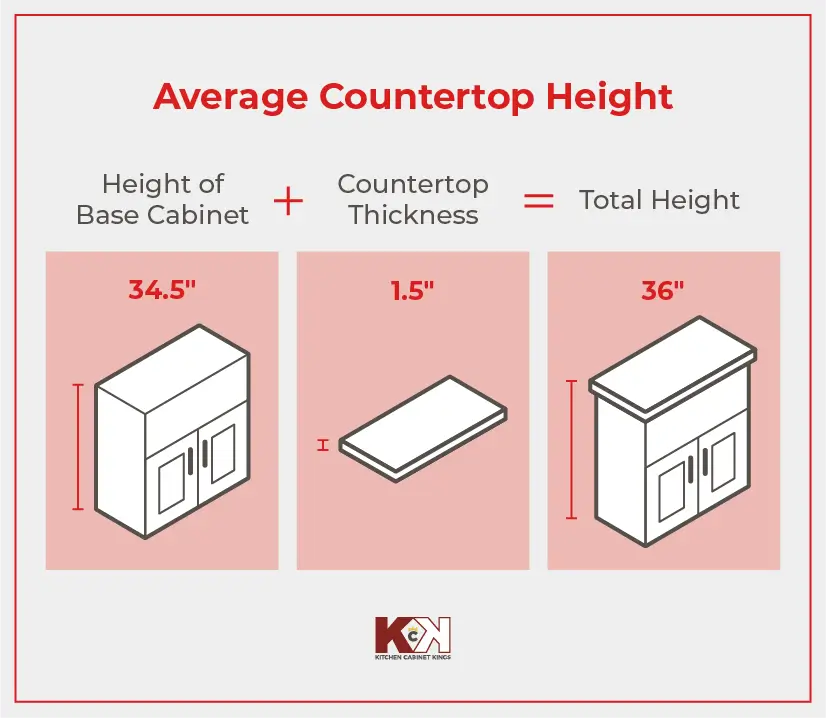
Image Source: cdn.kitchencabinetkings.com
The Standard Height Explained
What is the typical height for a kitchen counter? It’s usually 36 inches off the floor. This height is not random. Builders and designers agreed on this measurement long ago. It works well for many people doing kitchen work.
Why is this height the standard? The 36-inch height is often called the ergonomic kitchen height for the average person. When you stand at a counter this tall, you can chop, mix, and prepare food without bending too much or reaching too high. It helps prevent backaches and shoulder strain for most adults. Think about washing dishes or stirring a pot. This height puts the work surface at a good level for your arms and body. While people come in different sizes, 36 inches is a good middle ground that feels okay for many.
Components Making Up the Height
How do kitchen counters get to 36 inches tall? The height comes from two main parts: the cabinet below and the top slab itself.
Kitchen Base Cabinet Height
The foundation of your counter height is the cabinet unit under it. Kitchen base cabinet height is usually 34.5 inches. These cabinets sit directly on the floor. They provide storage and support the counter. The 34.5 inches cover the cabinet box and a small space at the bottom called the toe kick. This toe kick area is set back slightly. It lets you stand closer to the counter without your toes hitting the cabinet front.
Countertop Thickness
On top of the base cabinet sits the countertop material. The countertop thickness adds the final few inches to reach the standard height. Common materials like granite, quartz, laminate, and solid surface come in different thicknesses.
* Laminate tops often have a built-up edge, making them look thicker, usually around 1.5 inches to 2 inches.
* Natural stone or engineered stone slabs (like granite or quartz) are often cut to 1.25 inches (3 cm) or 0.75 inches (2 cm) thick.
| Material | Common Thickness | Contribution to Height |
|---|---|---|
| Laminate | 1.5 to 2 inches | 1.5 to 2 inches |
| Granite/Quartz | 1.25 inches (3 cm) | About 1.25 inches |
| Granite/Quartz | 0.75 inches (2 cm) | About 0.75 inches |
| Solid Surface | 0.5 to 1 inch | 0.5 to 1 inch |
| Butcher Block | 1.5 to 3 inches (or more) | 1.5 to 3 inches (or more) |
Add the typical base cabinet height (34.5 inches) to a common countertop thickness (like 1.5 inches).
34.5 inches (cabinet) + 1.5 inches (countertop) = 36 inches.
This shows how the standard 36-inch height is achieved using standard cabinet sizes and typical countertop thicknesses.
Different Heights for Different Needs
Not all kitchen surfaces are exactly 36 inches tall. Some parts of the kitchen might be higher or lower for specific purposes.
Kitchen Island Height
A kitchen island height can vary. Often, islands are the same height as the main counters, 36 inches. This makes them good for food prep, just like the counters around the edge of the kitchen. A 36-inch island offers extra workspace. People can stand and work at it comfortably.
However, islands can also be designed with different levels. A common design is to have one section at 36 inches for prep and another section raised higher.
Breakfast Bar Height
A breakfast bar height is usually higher than a standard counter. It’s designed more for casual eating or drinking while sitting on stools. Common breakfast bar heights are around 42 inches.
Why 42 inches? This height is similar to a traditional bar height. It lets people sit on tall stools (bar stools) and look over the main work area of the kitchen. It creates a clear divide between the kitchen work zone and a seating area. It’s not as good for standing and chopping because it’s too high for most people.
Counter Height vs. Bar Height
It’s helpful to know the difference between counter height and bar height:
- Counter Height: Typically 34 to 36 inches. This height is good for standing work or sitting on counter height stools. Counter height stools usually have seats about 24-26 inches from the floor.
- Bar Height: Typically 40 to 42 inches. This height is mainly for sitting on bar stools. Bar stools usually have seats about 28-30 inches from the floor.
Choosing the right stool is important for comfort. A stool that is too short or too tall for the surface height will be uncomfortable.
Making the Kitchen Accessible
Thinking about everyone who might use the kitchen is important. Some people use wheelchairs or have other mobility needs. For these people, standard heights don’t work.
ADA Kitchen Height Standards
The Americans with Disabilities Act (ADA) provides guidelines for making spaces accessible. ADA kitchen height standards suggest that at least one section of the countertop should be lower. This allows a person in a wheelchair to comfortably use the space.
Key points for ADA accessible counters:
- Height: The counter surface should be no higher than 34 inches from the floor. This allows a wheelchair user to roll under and reach the surface.
- Knee and Toe Clearance: There must be open space below the counter for knees and toes. This space should be at least 27 inches high, 30 inches wide, and 19 inches deep. This means cabinets cannot be directly under the accessible counter section. Often, this area is open with only a sink or cooktop installed, providing the required clearance.
- Clear Floor Space: There needs to be a clear space of at least 30 inches by 48 inches in front of the accessible counter section. This gives a wheelchair user room to maneuver.
While the standard 36-inch height works for many, having a section lowered to 34 inches meets accessibility needs. This is important in public spaces and is a good idea in homes where someone needs this feature now or might in the future.
Thinking About Ergonomics
Beyond the standard height, ergonomic kitchen height considers how the height affects your body over time. The goal of ergonomics is to make a workspace comfortable and safe.
How height impacts cooking comfort:
* Too Low: If the counter is too low, you have to bend over more. This can strain your back and neck, especially when prepping food for a long time. Imagine chopping vegetables or kneading dough on a low table – it’s not comfortable.
* Too High: If the counter is too high, you have to reach up or work with your shoulders raised. This can cause shoulder pain and make tasks like stirring or washing difficult. It can also be hard to apply downward force for chopping or mixing.
Tips for different user heights:
- For Taller People: The standard 36 inches might be too low. A slightly higher counter (like 37 or 38 inches) might be better for their back. This is often easier to do on an island or a specific section of the counter.
- For Shorter People: 36 inches might be too high. A height closer to 34 inches could be more comfortable for reaching and working. Again, this might be done in a specific area or if the whole kitchen is being built for someone shorter.
- Multi-height Kitchens: The most ergonomic kitchen might have counters at different heights. A 36-inch section for most tasks, a 30 or 32-inch section for rolling dough or tasks done while sitting, and perhaps a 42-inch section for a quick snack. This allows different family members or different tasks to have the ideal height.
Changing the whole kitchen height from the 36-inch standard is a big decision. It affects the kitchen base cabinet height, the workflow, and resale value. Most people stick to the standard height but might add a different height island or table section.
Related Kitchen Dimensions
Knowing the counter height is just one part of planning a kitchen. Typical kitchen dimensions involve many measurements that work together.
Upper Kitchen Cabinet Height
While base cabinets are under the counter, upper kitchen cabinet height matters for overall kitchen use. Upper cabinets are mounted on the wall above the counter.
- Space Above Counter: Usually, there is 18 inches of clear space between the standard 36-inch counter and the bottom of the upper cabinets. This space is good for small appliances like coffee makers or blenders. It also provides room for a backsplash.
- Upper Cabinet Depth: Upper cabinets are usually 12 to 13 inches deep, much less than base cabinets (which are typically 24 inches deep). This keeps them from feeling too bulky or hitting your head while working at the counter.
- Upper Cabinet Height: The cabinets themselves come in different heights, like 30 inches, 36 inches, or 42 inches. The total height of the wall determines how tall the upper cabinets can be or if they reach the ceiling.
These dimensions work together. The 36-inch counter, 18-inch backsplash area, and upper cabinets above create the common look and feel of a kitchen workspace.
Other typical kitchen dimensions:
* Walkway Clearance: Main walkways should be at least 36 inches wide. Work aisles (areas between counters or appliances) should ideally be 42 inches wide for a one-cook kitchen and 48 inches for a two-cook kitchen.
* Appliance Depths: Standard appliances like dishwashers and ranges are designed to fit with 24-inch deep base cabinets and counters.
Weighing Your Choices
Sticking to the 36-inch standard is safe. It works for most people and is what buyers expect if you sell your home. But there are times you might think about changing it.
When to Change the Standard Height
You might consider a different height if:
- You or a Family Member is Very Tall or Short: If the main user is much taller or shorter than average, adjusting the height slightly (an inch or two) in their primary work area can make a big difference in comfort.
- Accessibility is Key: As mentioned with ADA standards, a lower section is necessary for wheelchair users.
- Specific Tasks: You might want a lower section (around 30-32 inches) specifically for baking (like rolling dough) or a higher section (40-42 inches) for casual seating or a bar area.
Remember, changing the height means changing the base cabinets or building custom ones. This adds cost and complexity.
Working with Professionals
If you plan a kitchen remodel or a new build, talk to kitchen designers and contractors. They can help you understand:
- How different heights affect the layout and cost.
- How to mix different heights in a functional way.
- Meeting any necessary building codes, especially for accessibility.
They can also help you choose the right kitchen base cabinet height and countertop thickness to achieve your desired final counter height. Getting advice from experts is important for a successful kitchen project.
Frequently Asked Questions (FAQ)
Is 36 inches truly the minimum height?
No, 36 inches is the standard or typical height. It’s the most common and works for many. There is no strict rule saying all counters must be 36 inches. You can customize the height.
Can I have different counter heights in one kitchen?
Yes, absolutely! Many modern kitchens have different heights. An island might be one height, the main counters another, and a breakfast bar a third height. This can add interest and function.
How high should counter height stools be?
For a standard 34-36 inch counter, counter height stools usually have a seat height between 24 and 26 inches from the floor.
What is the best counter height for a tall person?
For someone significantly taller than average (e.g., over 6’3″), a height of 37 or 38 inches might be more comfortable for tasks like chopping, reducing back strain.
What is the best counter height for a short person?
For someone shorter than average (e.g., under 5’2″), a height of 34 inches might be more comfortable for reaching and working. ADA compliant counters are 34 inches high.
Does countertop thickness matter for the total height?
Yes, it definitely does. The countertop thickness is added to the kitchen base cabinet height to get the final total height of the counter surface. A thicker counter makes the total height greater if the cabinets are the standard 34.5 inches.
Are all kitchen island heights 36 inches?
No, kitchen island height is often 36 inches, matching the main counters for prep space. But islands can also have raised sections for seating (breakfast bar height, around 42 inches) or even lower sections (table height, around 30 inches).
Where can I find information on ADA kitchen height standards?
You can find detailed information on the official ADA website or through resources that explain ADA design guidelines for residential or public spaces. Kitchen designers specializing in accessibility are also good resources.
Besides height, what other typical kitchen dimensions are important?
Other important dimensions include the space between counters (typical kitchen dimensions for aisles), the space between the counter and upper cabinets (upper kitchen cabinet height spacing), and the depth of cabinets and appliances.
What is considered an ergonomic kitchen height?
An ergonomic kitchen height is a height that allows you to work comfortably with minimal bending or reaching, reducing strain on your back, neck, and shoulders. For many, this is around 36 inches, but the ideal height depends on the individual’s height and the specific task.
Choosing the right counter height is a key part of kitchen design. While 36 inches is the long-standing standard, considering different needs, functions, and accessibility can lead to a kitchen that is more comfortable and usable for everyone.