Image Source: cdn.kitchencabinetkings.com
How Deep Is A Kitchen Countertop? Standard Sizes Explained
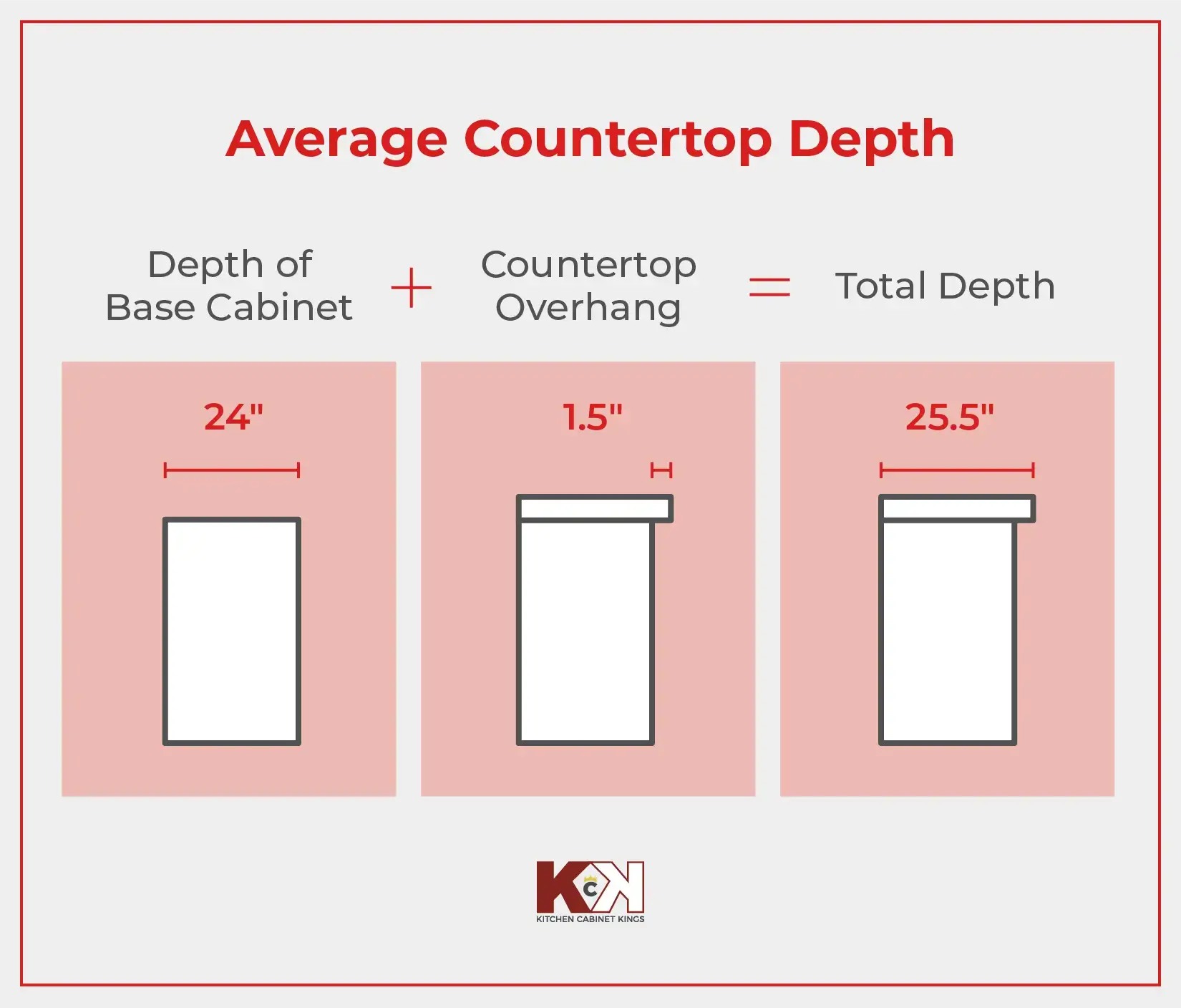
How deep are standard kitchen cabinets? Standard kitchen cabinets are usually 24 inches deep from the front to the back. This size helps set the usual size for the counter on top. A kitchen countertop normally sticks out a little past the front of the cabinets. This is why the standard kitchen countertop depth is a bit more than the cabinet depth, often around 25 inches. This is a common size you will see in many homes.
Grasping the Usual Countertop Size
Kitchen counters come in different materials. But they often share a common size. The standard kitchen countertop depth is usually 25 inches. This size works for most kitchens. It fits well with normal cabinets.
Why is this size common? Think about your cabinets. Standard kitchen cabinet depth is typically 24 inches. The counter sits on these cabinets. If the counter were only 24 inches deep, it would end right where the cabinet ends. This would not work well.
The extra inch or so gives you a small ledge. This ledge is called the countertop overhang depth. It lets drips fall to the floor, not on your cabinets. It also gives room for your fingers to open cabinet doors or drawers easily. This typical countertop dimension is practical for everyday cooking and cleaning.
The Foundation: Kitchen Base Cabinet Depth
The size of the counter on top depends a lot on what is underneath. Kitchen base cabinets are the boxes that sit on the floor. They hold up the counter. The depth of these cabinets is very important.
Most base cabinets have a standard kitchen cabinet depth. This depth is usually 24 inches. This measurement is taken from the very front of the cabinet box to the back. This size is common for many reasons.
- Fits Appliances: It is deep enough for dishwashers, ovens, and sinks to fit well in front of or inside the cabinets.
- Good Storage: 24 inches gives you decent space for pots, pans, and dishes.
- Material Use: Building cabinets this deep uses materials like plywood or particleboard efficiently. They often come in standard sizes that fit a 24-inch depth.
So, when we talk about the standard kitchen countertop depth, we must remember the standard kitchen cabinet depth below it. The counter is designed to work with these cabinets.
The Extra Bit: Countertop Overhang Depth
Look at your kitchen counter from the side. You will see it sticks out a little. This part is the overhang. The countertop overhang depth is the small distance the counter goes past the front of the cabinet doors or drawers.
How much does it stick out? It is often about 1 inch to 1.5 inches. So, if your cabinet is 24 inches deep, and the counter is 25 inches deep, the overhang is about 1 inch.
This small overhang does a lot of good things:
- Protects Cabinets: It catches spills. Liquids drip onto the floor, not down the front of your nice cabinets. This helps keep your cabinet doors clean and prevents damage over time.
- Makes Doors Easy: It gives you room to reach under the counter edge. This makes opening cabinet doors and drawers simple. Your fingers have space to grab the pulls or the door edge itself.
- Looks Better: It gives the counter a finished look. It hides the top edge of the cabinet box slightly. It creates a shadow line that looks nice.
Sometimes, the overhang is slightly different. It might be a little more or less. But the usual amount is key to the standard kitchen countertop depth of 25 inches.
Normal Counter Sizes Explained
Let’s talk more about the typical countertop dimensions. While depth is our main focus, counters also have length and thickness.
- Depth: As we know, the most common depth is 25 inches. This includes the overhang over a standard 24-inch deep base cabinet.
- Length: Counter lengths vary a lot. They are cut to fit your kitchen layout. They can be just a few feet long for a small section. Or they can run many feet along a wall. Slabs of material like granite or quartz come in big sizes, but they are cut down to fit. Laminate counters might come in pre-cut lengths you join together.
- Thickness: The edge thickness you see is usually 1.5 inches (about 3 cm). The main part of the slab might be thinner (like 3/4 inch or 2 cm). But the edge is often built up to look thicker. This thicker edge gives the counter a solid look. It also makes the edge strong.
So, when we talk about typical countertop dimensions, we think about a depth of 25 inches, a common thickness of 1.5 inches at the edge, and a length that fits your kitchen’s design. These are the average kitchen countertop depth and other sizes you’ll see often.
Table: Common Countertop Sizes
| Part of Counter | Typical Size | Notes |
|---|---|---|
| Depth | 25 inches (63.5 cm) | Fits over 24-inch deep standard cabinets |
| Overhang | 1 to 1.5 inches | Front edge past cabinet doors |
| Thickness | 1.5 inches (3-4 cm) | Often the finished edge thickness |
| Base Cabinet Depth | 24 inches (61 cm) | The standard size underneath |
This table shows the usual numbers. These sizes work together to make a usable kitchen space.
Kitchen Island Depth: A Different Story
Kitchen islands can have different sizes than counters along a wall. The kitchen island depth can vary more.
Why is this? Perimeter counters must fit against a wall. They also need to fit over standard kitchen cabinet depth of 24 inches. Islands are free-standing. They can be accessed from all sides.
An island often uses base cabinets that are 24 inches deep. But the countertop on the island might be deeper.
- Single-sided use: If the island has cabinets on one side and is meant to be used from that side (like along a wall), the counter depth might still be 25 inches, just like a regular counter.
- Double-sided use: Some islands have cabinets or seating on both sides. In this case, the island depth could be much larger. You might have 24-inch deep cabinets facing one way and 12-inch deep cabinets or seating space facing the other. The total counter depth could be 40 inches or more. This gives room for people to sit at the island on one side while you work on the other.
- Extra Overhang for Seating: If you want to put stools at an island, you need a deep overhang. This overhang gives legroom for people sitting there. A comfortable overhang for seating is usually 12 to 15 inches. So, an island counter with seating might be 36 inches deep (24-inch cabinet + 12-inch overhang) or even deeper.
So, while the standard kitchen countertop depth is 25 inches for wall counters, kitchen island depth can be much bigger. It depends on how you plan to use the island. This shows that while there are standard sizes, design needs can change things.
Simple Steps: Countertop Measurement Guide
If you are getting new counters, you need to measure your space. This measurement guide helps you get the right sizes. Getting the right numbers is very important.
Here are the basic steps for measuring:
- Measure Cabinets First: Start with the base cabinets. Measure their depth. Measure from the front face of the cabinet box to the wall. This confirms your standard kitchen cabinet depth. Most will be 24 inches deep. Note any spots where cabinets are deeper or shallower.
- Measure Lengths: Measure the length of each straight section where a counter will go. Measure along the back wall. Also, measure along the front edge of the cabinets. Use the longer number if they are different.
- Note Corners: If you have corners, think about how the pieces will join. You might need to measure from the corner out along each wall.
- Mark Appliances: Write down where your sink, stove, and fridge will be. These need special cuts in the counter. Measure their sizes and locations carefully.
- Plan Overhangs: Decide on your desired countertop overhang depth. The standard is 1 to 1.5 inches for counters against walls. For islands, decide if you need seating overhang. Measure how deep you want the total island counter to be.
- Add for Edges: Remember to add for overhangs when ordering. If cabinets are 24 inches deep and you want a 1-inch overhang, the total counter depth needed is 25 inches.
- Use a Template for Tricky Shapes: For L-shaped or U-shaped counters, or if your walls are not straight, the installer might make a template. A template is like a full-size pattern of the counter shape. This ensures a perfect fit.
A good countertop measurement guide is key. It helps you order the right amount of material. It also makes sure the counter fits your cabinets and appliances perfectly. Getting these typical countertop dimensions right saves time and money.
When You Need Custom Countertop Sizes
Most kitchens can use standard sizes. But sometimes, you need something different. This is where custom countertop sizes come in.
Why would you need a custom size?
- Old Homes: Older houses might have cabinets that are not a standard size. They might be shallower or deeper than 24 inches. A standard 25-inch counter might not fit right.
- Special Cabinets: You might have custom-built cabinets. These could have non-standard depths or shapes.
- Unique Layouts: Some kitchens have unusual angles or curves. Standard straight pieces won’t work.
- Design Choice: You might just want a deeper counter for more workspace. Or a shallower one for a narrow kitchen. You might want a very large island.
- Special Appliances: Some appliances, like large commercial-style ranges, might stick out more. You might want a deeper counter to line up with them.
When you need custom countertop sizes, the process changes a bit. You can’t just order a standard slab. You need someone to measure your specific space very accurately. They will then cut the counter material to fit your unique dimensions. This usually costs more than using standard sizes. But it ensures a perfect fit and look for your specific kitchen.
Even with custom sizes, the average kitchen countertop depth for wall counters still often aims for something near 25 inches. This is because the standard cabinet depth is so common. But the beauty of custom is you can get exactly the depth you want.
Reviewing the Average Kitchen Countertop Depth
Let’s review the main point. The average kitchen countertop depth for counters along a wall is 25 inches. This number is very common. It is seen in most kitchens built today.
This 25-inch depth works because it sits on standard kitchen cabinet depth. Standard cabinets are usually 24 inches deep. The extra inch gives the counter a helpful overhang.
This 25-inch size is a typical countertop dimension. It makes kitchens work well. It gives enough space for daily tasks like preparing food. It allows sinks and cooktops to fit correctly.
Of course, this is an average or standard size. As we saw, kitchen island depth can be different. Custom sizes are also possible. But if someone asks about the usual depth of a kitchen counter, 25 inches is the number to remember.
Understanding this standard size helps you plan your kitchen. It helps you buy the right cabinets and counters. It ensures everything fits together well.
Why Are These Sizes Standard?
There are good reasons why sizes like 24-inch deep cabinets and 25-inch deep counters became standard.
- Ergonomics: These sizes feel right for most people. A 25-inch deep counter lets you reach to the back easily. It gives enough workspace in front of you.
- Material Efficiency: Building materials, like sheets of plywood or laminate, often come in sizes (like 4×8 feet) that work well with 24-inch cabinet depths with minimal waste.
- Manufacturing: Companies that make cabinets and counters can make them in large amounts in standard sizes. This makes them cheaper to produce.
- Installation: Installers know how to work with standard sizes. It makes their job faster and easier. Everything is designed to fit together.
- Planning: It makes planning a kitchen easier. Designers know the standard sizes. They can quickly lay out a functional kitchen.
These standard sizes create a baseline. They provide a starting point for almost every kitchen project. While custom options exist, knowing the standard kitchen countertop depth and standard kitchen cabinet depth is key.
Deeper Dive into Materials and Edges
The material your counter is made of can affect things slightly. But the standard depth remains mostly the same across materials.
- Laminate: Often built on a particleboard base. Comes in standard sizes or rolls. Edges can be simple or rounded. The 25-inch depth is very common for laminate.
- Granite, Quartz, Marble: Cut from large slabs. The main part might be 3/4 inch or 1.25 inches thick. The front edge is often made to look thicker, usually 1.5 inches. The total depth is still cut to the standard 25 inches for perimeter counters.
- Solid Surface (like Corian): Can be shaped easily. Seams are less visible. The depth is typically 25 inches. Edges can be molded into many shapes.
- Wood/Butcher Block: Can be ordered in standard sizes or custom cut. The thickness varies. The depth for wall counters is usually 25 inches.
No matter the material, the goal is often to achieve that useful 25-inch standard kitchen countertop depth over the 24-inch standard kitchen cabinet depth.
The edge style you choose can affect the look of the thickness and overhang slightly, but not the main depth of the counter slab itself. For example, a very decorative edge might add a tiny fraction of an inch, but the overall depth measurement remains from the back edge to the front edge.
Putting It All Together: A Countertop Measurement Guide Summary
Let’s quickly summarize the countertop measurement guide. Getting the right measurements means knowing the standard sizes and how they relate.
- Measure cabinets first to find the base depth (usually 24 inches – standard kitchen cabinet depth).
- Plan for the overhang (usually 1 inch to 1.5 inches – countertop overhang depth).
- Add the cabinet depth and overhang to get the total counter depth needed (usually 24 + 1 = 25 inches – standard kitchen countertop depth).
- Measure lengths of each section.
- Note appliance locations and sink type (top-mount or undermount needs different cuts).
- Consider islands separately (kitchen island depth varies based on use, often deeper than 25 inches).
- Think about custom needs (custom countertop sizes) if your kitchen is not standard.
Using a careful measurement guide ensures your new counters fit perfectly. Knowing the typical countertop dimensions helps you double-check the plan.
Common Questions About Countertop Depth
Here are some questions people often ask about how deep kitchen counters are.
Is a 24-inch deep countertop possible?
Yes, it is possible to have a 24-inch deep countertop. However, this means the counter would end right at the front of a standard 24-inch deep cabinet. There would be no front overhang. This is not typical. It is less practical for catching spills and makes opening cabinet doors harder. It might be used in very tight spaces or for specific design reasons, but it is not the standard kitchen countertop depth.
What is the maximum depth for a kitchen counter?
There is no strict maximum depth. Custom countertop sizes can be made very deep. For islands, depths of 40, 48 inches, or even more are common, especially when allowing for seating. Perimeter counters against a wall are limited by how far you can comfortably reach (usually around 25-30 inches deep is practical). Very deep counters along a wall can make it hard to clean the back wall or access things stored at the back of the counter.
Does the counter depth include the backsplash?
No, the counter depth measurement is just for the flat surface area of the counter itself. It measures from the front edge to the back edge where it meets the wall. The backsplash is a separate piece that goes up the wall behind the counter.
How deep should an island be for seating?
For comfortable seating at a kitchen island, you need enough knee space. A countertop overhang depth of at least 12 inches is recommended for seating. Some prefer 15 inches. So, if you have cabinets on one side (24 inches deep), the total island depth for seating on the other side would be at least 24 inches (cabinet) + 12 inches (overhang) = 36 inches total depth.
Can I put a 25-inch deep counter on shallower cabinets?
Yes, you can put a 25-inch deep counter on cabinets that are shallower than 24 inches. For example, if you have old cabinets that are only 22 inches deep, you could still use a 25-inch deep counter. This would give you a larger overhang in the front (25 – 22 = 3 inches). Or, you could leave the standard 1-inch overhang in the front and have the counter stick out more at the back towards the wall (if space allows and it doesn’t interfere with plumbing or outlets).
Is there a standard height for kitchen counters?
Yes, while this post is about depth, there is also a standard height. The standard height from the floor to the top of the counter is usually 36 inches. This height is comfortable for most adults to work at. Base cabinets are usually around 34.5 inches tall, and the 1.5-inch thick counter on top makes the total height 36 inches.
Does countertop thickness affect depth?
No, countertop thickness affects how tall the edge looks and how the counter looks overall, but it does not change the depth measurement. The depth is measured horizontally from front to back. A thick-looking edge is usually created by building up the material at the front edge, not by using a single thick slab across the whole depth (though very thick slabs exist for unique designs). The standard depth of 25 inches applies no matter if the edge looks thin or thick.
What is the most common material for the standard 25-inch depth?
Almost all countertop materials are commonly cut to the standard 25-inch depth. This includes laminate, granite, quartz, solid surface, and wood. Because the standard kitchen cabinet depth is 24 inches and the need for a small overhang is universal, manufacturers and fabricators make counters in the 25-inch size from all popular materials.
Conclusion
The depth of your kitchen counter is a key part of its function. The standard kitchen countertop depth of 25 inches is very common. It is based on the standard kitchen cabinet depth, which is usually 24 inches. This allows for a small, helpful countertop overhang depth of about 1 inch.
Knowing these typical countertop dimensions helps when planning a new kitchen or updating an old one. While kitchen island depth and custom countertop sizes can vary, the 25-inch depth serves as the average kitchen countertop depth for most main work surfaces.
Using a simple countertop measurement guide is vital to get the right fit. Understanding how deep are standard kitchen cabinets helps explain why the counter is the size it is. All these standard sizes work together to create kitchens that are both useful and nice to look at for many years.